Your Cart (0)


Few upgrades change the look, stance, and trail performance of a classic Bronco faster than the right set of wheels and tires. Whether you're keeping your 66-77 Ford Bronco close to factory spec or building something ready for the dirt, the right combination affects ride quality, steering feel, clearance, and overall capability. This guide breaks down factory specs, bolt patterns, backspacing and offset, Bronco wheel history, beadlocks, and tire sizing for both cut and uncut fenders so you can choose a setup that fits your Bronco and the way you use it.
Early Bronco Tires & Wheels Guide: The Short & Sweet Version
Early Bronco Wheels & Tires: The Short & Sweet Version
Choosing wheels and tires for a 66-77 Ford Bronco mainly comes down to bolt pattern, backspacing, lift height, and cut vs uncut fenders.
Basic Specs
-
Bolt Pattern: 5 on 5.5
-
Lug Studs: 1/2-20
-
Ideal Backspacing: 3.5–4.25 inches
Too much backspacing can cause suspension rub. Too little pushes tires too far outward.
Factory Setup
-
Wheels: 15x5.5, 15x6, or 16x5
-
Tires: roughly 28–30 inches tall
Common Modern Wheel Sizes
-
15x7 or 15x8 – classic Bronco look
-
17x8 or 17x9 – more modern tire options and brake clearance
Typical Tire Sizes
-
Uncut Broncos: ~30–31" tires
-
Cut Broncos (2.5–3.5" lift): 33" tires are the sweet spot
-
4.5–5.5" lift: 35" tires are common
Beadlocks
-
Useful for extreme off-road use at 5–10 PSI
-
Simulated beadlocks give the look without the maintenance
Bottom Line: Match your wheels and tires to how the Bronco is used, and always verify brake clearance, steering clearance, suspension travel, and backspacing before ordering.
Don’t want to read the whole guide? We think it’s worth your time, but if you’re in a hurry, click above for the summarized version.
Quick Index
- Factory Wheel & Tire Specifications
- Early Bronco Bolt Pattern Explained
- Backspacing vs Offset Explained
- Choosing the Right Wheel Width & Diameter
- US Mags and Bronco Wheel History
- Beadlock Wheels: When to Use Them and When Not To
- Tire Sizes for Stock, Lifted, Cut & Uncut Broncos
- Lift Height vs Tire Size Chart
- Final Tips for Choosing the Right Setup
Factory Wheel and Tire Specifications
Before moving into larger wheels and modern off-road tires, it helps to understand how the Early Bronco was originally equipped from the factory. When the 66-77 Ford Bronco was introduced, it was designed around relatively narrow steel wheels and tall sidewall bias-ply tires - aka pizza cutters. This combination delivered a comfortable ride, good off-road traction, and plenty of suspension travel without interference from the body or chassis.
To the best of our knowledge, Ford offered three wheel sizes from the factory. The standard wheel was a 15x5.5 steel wheel. Some higher GVW Bronco models were equipped with slightly wider 15x6 wheels. An optional 16x5 wheel was also available on certain models, particularly those configured for heavier-duty use.
All Early Broncos shared the same basic wheel mounting specs:
- Bolt Pattern: 5 on 5.5 inches
- Lug Stud Size: 1/2-20 thread
- Factory Wheel Sizes: 15x5.5 (standard), 15x6, 16x5
Tires originally installed on Early Broncos used the bias-ply sizing system common during the 1960s. These sizes look very different from modern radial tire sizing, but they generally equate to tires in the 28 to 30 inch overall diameter range.
Factory Tire Sizes by Model
The original owner's manual lists several tire size options depending on Bronco model and gross vehicle weight rating (GVW).
U140 Pickup & U130 Roadster – 3900 GVW
- 7.35x15 B-PT (standard)
- 7.75x15 B-PT
- 8.25x15 B-PT
- 7.75x15 D-PT
U150 Wagon – 3900 GVW
- 8.25x15 D-PT (standard)
- 9.15x15 B-PT
- 6.5x16 6PR TT
U142 Pickup & U152 Wagon – 4700 GVW
- 8.25x15 D-PT (standard)
- 9.15x15 B-PT
- 6.5x16 6PR TT
What Those Tire Sizes Mean Today
Bias-ply tire sizing was based primarily on section width rather than modern aspect ratios. When converted to modern radial equivalents, most of these factory tires fall roughly into the following size range:
- 7.35x15 ≈ about 28" tall, similar to a modern 215/75R15
- 7.75x15 ≈ about 29" tall
- 8.25x15 ≈ about 29–30" tall, similar to a modern 235/75R15
- 9.15x15 ≈ about 30–31" tall
- 6.50x16 ≈ about 30" tall narrow tire
By modern off-road standards these are relatively small tires, which is why stock Broncos often appear to have a large amount of open space inside the wheel wells. That extra room is one reason Early Broncos respond so well to mild suspension lifts and slightly larger tires. Even a modest lift can comfortably accommodate larger modern tire sizes while maintaining good clearance and suspension travel.
Early Bronco Tire Size Conversion Calculator
Convert between bias-ply, metric radial, and flotation tire sizes. These conversions are approximate and meant as a fitment guide, not an exact manufacturer-to-manufacturer match.
Supported examples: 8.25x15, 235/75R15, 31x10.50R15
Convert from Bias-Ply
Convert from Metric Radial
Convert from Flotation
Enter a tire size above to see the approximate conversions.
Notes
- Bias-ply conversions are based on commonly accepted historical equivalents and are approximate.
- Metric and flotation conversions are calculated from tire height and width, then rounded to common published sizes.
- Actual mounted size varies by manufacturer, tread design, wheel width, and load range.
- Always verify tire clearance on your 66-77 Ford Bronco before ordering.
Early Bronco Bolt Pattern | 5 on 5.5
All 66-77 Ford Broncos use a 5 on 5.5 wheel bolt pattern, also written as 5x5.5 or 5x139.7mm in metric. If you are looking at metric wheels, you can select 5x139.7 lug pattern - this is identical to the 5x5.5 pattern. These numbers mean the wheel uses five lug holes arranged on a 5.5-inch circle (or 139.7mm).
This bolt pattern is shared with many classic Ford trucks and some older Jeep applications, which has helped keep a plethora of aftermarket wheel options available for Early Broncos. It is always important to verify exact fitment before ordering wheels. Bolt pattern must match exactly. Adapters are available, but highly discouraged unless absolutely necessary.
How do you measure wheel bolt patterns?
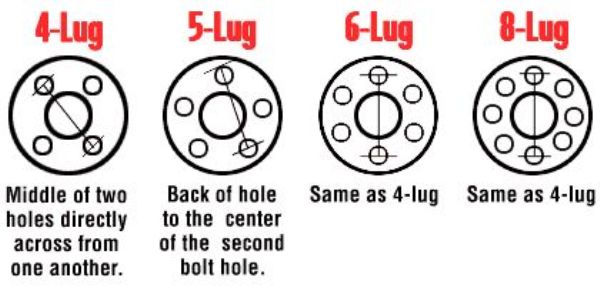
Once you understand the basics, measuring the wheel bolt pattern on your vehicle is straightforward. The bolt pattern is simply the number of bolt holes on the wheel by the diameter of the bolt circle. The bolt holes on every automotive wheel should be evenly spaced, so having just the number of bolts and circle diameter is adequate for identifying the wheel bolt pattern. The bolt circle is the circle determined by the positions of the bolts; the center of every bolt lies on the circumference of the bolt circle.
Measuring the PCD of a Wheel
Measuring the bolt circle is often the confusing part of identifying a vehicles wheel lug pattern. The measurement you are looking for is called the Pitch Circle Diameter (PCD). It is usually expressed in millimeters, but can sometimes be expressed in inches as well. For wheels with even amounts of bolts such as 4-bolt or 6-bolt wheel patterns, the PCD measurement is straightforward. Just measure the distance between the center of two diametrically opposite bolts.
Measuring a wheel with an odd number of bolts, most commonly a 5-bolt pattern, requires a bit more science. If your wheel has a 5-bolt pattern, measure from the BACK of one bolt hole to the center of the second bolt hole as shown in the diagram. You can also measure from the CENTER of one bolt hole to the CENTER of the third hole, and then multiply this result using a multiplier of 1.05 to find your bolt circle diameter.
Backspacing vs Offset Explained
Backspacing and offset both describe where the wheel sits in relation to the hub, suspension, and fender, but they are measured differently. Understanding both is important because these numbers have a direct effect on clearance and stance.
What is Offset?
Offset is the distance between the wheel's mounting surface and its centerline. It is usually measured in millimeters.
- Positive offset moves the wheel further inward toward the suspension.
- Negative offset pushes the wheel further outward toward the fender.
- Zero offset places the mounting surface near the wheel centerline.
What is Backspacing?
Backspacing is the distance from the wheel mounting surface to the inside edge of the wheel. It is usually measured in inches and is the measurement most Early Bronco owners pay attention to because it directly affects clearance at the radius arms, steering linkage, frame, and inner fenders.
- More backspacing tucks the wheel further inward.
- Less backspacing pushes the wheel further outward.
For most 66-77 Ford Broncos, wheel backspacing in the 3.5 to 4.25 inch range works well depending on wheel width, tire width, brake setup, and suspension components. Too much backspacing can push the tire into the radius arms or suspension. Too little can push the tire too far outside the body and increase the chance of fender rub.
Wheel Offset & Backspacing Calculator
Use this calculator to convert between offset and backspacing based on wheel width. Enter wheel width as the advertised wheel width (ex: 8 for a 15x8 wheel). This tool uses the common industry rule of adding approximately 1 inch to account for overall wheel lip width when calculating backspacing.
Calculate Backspacing
From offset + wheel width
Enter values above to calculate backspacing.
Calculate Offset
From backspacing + wheel width
Enter values above to calculate offset.
How the Math Works
Backspacing formula:
Backspacing = ((Wheel Width + 1) / 2) + (Offset / 25.4)
Offset formula:
Offset (mm) = (Backspacing - ((Wheel Width + 1) / 2)) × 25.4
The extra 1 inch accounts for the approximate total wheel lip width. This is the standard shortcut commonly used when comparing published wheel width to measured backspacing.
Choosing the Right Wheel Width & Diameter
Factory wheels were narrow, but most aftermarket Bronco builds run wider wheels to better support modern tire sizes. The right wheel width depends on the tire you plan to run and the look and performance you want.
Common Wheel Sizes for Early Broncos
- 15x7 - Good for traditional builds and moderate tire sizes like 31x10.50R15.
- 15x8 - One of the most popular Early Bronco wheel sizes, commonly paired with 31x10.50R15 or 33x12.50R15 tires.
- 17x8 - Popular on more modern builds where tire selection in 17-inch sizes is stronger.
- 17x9 - Common on aggressive builds running larger tires and a wider stance.
Fifteen-inch wheels still fit the character of a classic Bronco and provide a taller sidewall for a more traditional off-road look and feel. Seventeen-inch wheels open up more modern tire choices and are often used when larger brakes or a more current wheel style are part of the build.
More Early Bronco owners are moving to 17-inch or larger wheels. Part of this shift comes from changing style preferences, but it is also driven by the growing popularity of larger disc brake conversions that often require more wheel clearance than a 15-inch wheel can provide.
US Mags and Bronco Wheel History
When discussing classic wheel styles for the Early Bronco, it’s hard to ignore the influence of US Mags. Their designs became closely tied to the off-road racing culture that helped shape the Ford Bronco’s reputation during the late 1960s and early 1970s.
One of the biggest contributors to that legacy was legendary race builder Bill Stroppe. Working in collaboration with Ford, Stroppe developed the famous Baja Broncos—special performance builds designed to showcase the Bronco’s capabilities in desert racing and high-speed off-road environments.
Many of the Stroppe Baja Broncos were equipped with lightweight aluminum mag-style wheels produced by US Mags. At a time when most trucks still ran heavy steel wheels, aluminum mag wheels offered a meaningful advantage in desert racing. They helped reduce unsprung weight while providing strong, durable wheels capable of handling the punishment of long-distance desert competition.
These Broncos competed in events such as the Baja 500 and Baja 1000, where reliability and durability were just as important as speed. As the Baja Broncos gained recognition, the look of wide off-road tires mounted on aluminum mag wheels quickly became associated with serious Bronco performance.
Many racers and off-road enthusiasts followed the lead of the Stroppe team, adopting similar mag-style wheels for their own builds. The slotted mag and five-spoke aluminum designs became a defining visual element of modified Broncos throughout the 1970s.
Today, US Mags continues producing wheels inspired by those original designs while using modern manufacturing techniques. For Bronco owners looking to capture the vintage desert racing style made famous by the Stroppe Baja Broncos, these wheels remain one of the most recognizable and historically connected choices.
Beadlock Wheels: When to Use Them and When Not To
Beadlock wheels mechanically clamp the tire bead to the wheel using a bolted outer ring. Their main purpose is to keep the tire from unseating from the wheel when running very low air pressure off-road.
When Beadlocks Make Sense
Beadlocks are most useful in situations where maximum traction is needed and tire pressures are intentionally lowered. This commonly includes rock crawling, deep sand, and other extreme off-road conditions where drivers may air down to pressures as low as 5–10 PSI.
At these pressures, a standard wheel can allow the tire bead to slip or unseat under heavy side loads. A true beadlock wheel prevents this by mechanically clamping the outer bead of the tire to the wheel with a bolted ring.
Maintenance Considerations
One important thing to understand about true beadlock wheels is that they require regular maintenance. The beadlock ring is secured with multiple bolts that must be checked and re-tightened periodically.
As a general rule, beadlock bolts should be inspected and re-torqued on a regular basis, especially after hard trail driving. Because of this maintenance requirement, beadlock wheels can be inconvenient for Broncos that see frequent street use or rack up a lot of miles as daily drivers.
Simulated Beadlocks
For owners who like the aggressive look of beadlocks but do not want the maintenance requirements, simulated beadlock wheels are a popular option.
Simulated beadlocks feature a beadlock-style ring design built directly into the wheel. While they visually resemble traditional beadlocks, the ring does not clamp the tire bead. Instead, the tire bead is seated normally like a standard wheel.
Because of this design, simulated beadlocks do not provide the same clamping capability as true beadlocks. However, they are a great option for Bronco owners who want the beadlock appearance without the added maintenance or complexity.
Tire Sizes for Stock, Lifted, Cut & Uncut Broncos
Tire fitment on a 66-77 Ford Bronco depends heavily on two things: ride height and whether the rear fenders are cut or uncut. That second part matters more than many people expect.
Uncut Broncos
Uncut Broncos retain the factory rear quarter openings. While this keeps the classic original look, it also limits tire clearance compared to Broncos with cut fenders and flares.
Running taller tires with uncut fenders usually means running a narrower tire than you otherwise might choose. This allows the tire to tuck up inside the quarter panel during suspension compression without contacting the sheet metal.
One trick sometimes used to gain a small amount of extra clearance is to roll the inner lip of the rear quarter panel. This can create just enough room to help prevent rubbing with slightly taller tires.
A common shade-tree method involves placing a short section of 2x4 between the tire and the underside lip of the quarter panel. With the board resting on the tire, carefully push down on the outer end of the 2x4 so it rocks against the tire and gently rolls the inner lip of the quarter panel upward and inward. This can slightly flatten the inner edge of the sheet metal and create a bit more clearance.
Use caution if attempting this. We cannot take responsibility for damage if this technique is done incorrectly. If too much pressure is applied, it can crease the panel or damage paint. When done carefully, however, it can be a useful trick for gaining a little extra tire clearance while keeping the factory uncut look.
Cut Broncos
Cut Broncos have enlarged rear wheel openings, usually paired with fender flares. This opens the door to much larger tire sizes and is one of the biggest reasons modified Broncos can run 35s, 37s and even 40s with far fewer clearance issues.
Once the rear quarters are cut, lift height, wheel specs, and suspension travel become the next major fitment factors rather than the quarter panel opening itself.
When cutting the rear quarters, the front fenders typically should be cut as well. This allows for flares on all four wheel openings which provides a cleaner, more consistent look. The front fenders are also known to cause tire clearance issues as you go to larger tires due to the way the wheel opening cuts back in toward the bottom front of the fenders.
Lift Height vs Tire Size Chart
The chart below is a general guide. Actual fitment can vary based on wheel width, backspacing, tire brand, suspension design, body mount condition, axle centering, and how hard the Bronco is used off-road.
Stock Height to 1.5-Inch Lift
- Uncut fenders: 29-30 inch tires are usually the safe zone.
- Typical sizes: 235/75R15, 30x9.50R15.
- 31-inch tires: possible in some cases, but rubbing is more likely.
2.5-Inch Lift
- Uncut fenders: up to 31-inch tires is a common target.
- Cut fenders: Common to run 33-inch tires though rubbing is a concern.
- Typical sizes: Uncut - 31x10.50R15, 265/75R16 | Cut - 33x10.50R15, 33x12.50R15.
- Notes: wheel backspacing and tire width still matter, especially at full turn or suspension compression.
3.5-Inch Lift
- Uncut fenders: up to 32-inch tires should fit though they will need to be narrow. Potential need for some trimming of the lower front wheel opening for clearance.
- Cut fenders recommended: 33-inch tires are a common match while 35-inch tires can be used but expect some rubbing if not adding a body lift.
- Typical sizes: 33x10.50R15, 33x12.50R15, 35x12.50R15, 35x12.50R17.
- Notes: this is one of the most popular Early Bronco lift-and-tire combinations because it offers a strong stance without going too far.
4.5 to 5.5-Inch Lift
- Uncut fenders: up to 33-inch tires. Must be narrow and expect to at least do some trimming on the lower front wheel opening for clearance.
- Cut fenders recommended: 35-inch tires are common at this height though many Bronco owners opt for 37's or even 40's. Expect added trimming and likely body lift to accommodate the larger options.
- Typical sizes: 35x12.50R15, 35x12.50R17.
- Notes: larger tires at this level often call for gearing, steering, braking, and driveline upgrades to keep the Bronco working properly.
General Rule of Thumb
- Stock to mild lift + uncut fenders: stay around 30-31 inches.
- 2.5 to 3.5-inch lift + cut fenders: 33-inch tires are the sweet spot for many Broncos.
- 4.5 to 5.5-inch lift + cut fenders: 35-inch tires are common, but supporting mods become more important.
- Body lift: If you need a bit more clearance without stepping up the suspension, a body lift can be used to gain added tire clearance.
Final Tips for Choosing the Right Wheels & Tires for your Bronco
The best wheel and tire setup is the one that matches how your Bronco is actually used. A clean street-driven uncut Bronco and a trail-built cut Bronco may both wear great-looking wheels, but the ideal specs for each will be very different.
- For a classic driver build: 15x7 wheels, moderate backspacing, and 30-31 inch tires usually keep things simple and period-correct.
- For a balanced trail and street Bronco: 15x8 wheels and 33-inch tires are a proven combination on a cut Bronco with a 3.5-inch lift.
- For dedicated off-road use: larger tires, wider wheels, and possibly beadlocks may make sense, but only if the rest of the Bronco is built to support them.
Before ordering wheels and tires, always verify brake clearance, steering clearance, suspension travel, and intended ride height. Small changes in wheel width, tire section width, or backspacing can make the difference between a setup that fits right and one that rubs every time you turn or flex the suspension.
Done right, the right wheel and tire package gives your Early Bronco the stance, function, and trail confidence it was meant to have.